ADHD is one of the most researched conditions in psychiatry, and also one of the most misrepresented online. Despite decades of consistent findings, myths about it circulate constantly: that it isn't real, that it's just bad parenting, that medication is dangerous, that a brain scan could settle the question either way.
The International Consensus Statement on ADHD was put together specifically to counter this. It's curated by the ADHD Evidence Project, a group led by researchers who reviewed the scientific literature and selected only the studies that met a very high bar of evidence: meta-analyses and very large studies, not single small papers or preliminary findings.
The scale of it
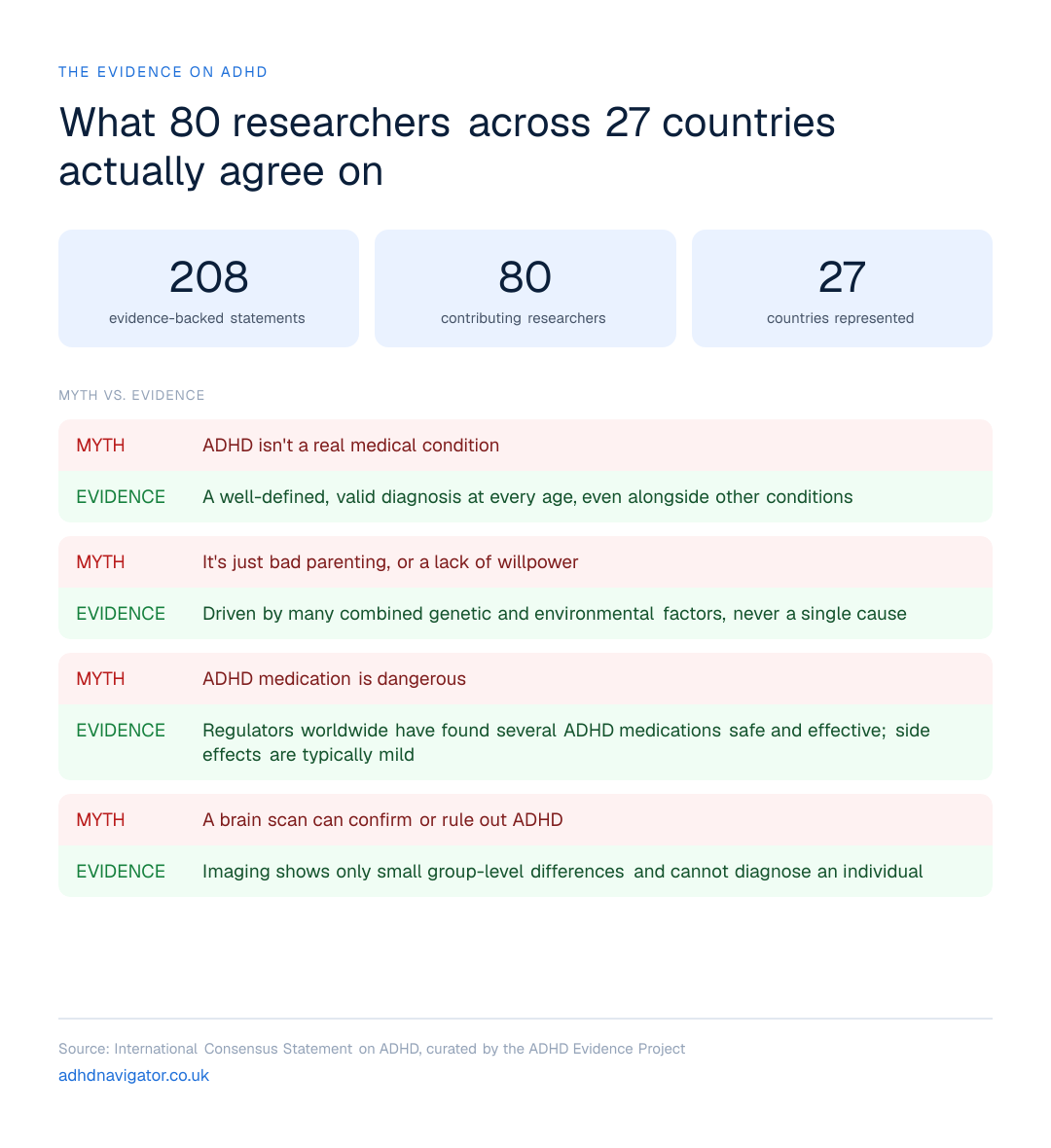
The statement isn't the opinion of one clinic or one country's health service. It's 208 separate conclusions, each individually supported by strong evidence, written and endorsed by 80 researchers across 27 countries — spanning Europe, North America, South America, Asia, Australia, and the Middle East.
A few of the myths it actually addresses
- ✓“ADHD isn't a real medical condition.” When made by a licensed clinician, the diagnosis is well-defined and valid at every age, even when other psychiatric conditions are also present — which is common.
- ✓“It's just bad parenting or a lack of willpower.” ADHD is rarely caused by a single genetic or environmental factor. Most cases come from the combined effect of many small genetic and environmental risks, not one identifiable cause.
- ✓“ADHD medication is dangerous.” Regulatory agencies around the world have determined that several ADHD medications are safe and effective, based on randomised controlled trials. Side effects are typically mild and can usually be managed by adjusting the dose or medication.
- ✓“A brain scan could confirm it.” Imaging studies do find small differences in brain structure and function between people with and without ADHD — but these differences are only visible at a group level in research, and cannot be used to diagnose an individual.
Why this matters beyond the statistics
None of this is trivia. Believing the myths has real consequences: people delay getting assessed because they've convinced themselves ADHD “isn't real” for adults, or that treatment is riskier than living with undiagnosed symptoms. The evidence says otherwise on both counts.
If you recognise ADHD traits in yourself and have been holding off because of something you read online, it's worth checking whether that claim actually holds up against 20 years of research — or take our free 3-minute screener to see where you stand.
Source: International Consensus Statement on ADHD, curated by the ADHD Evidence Project from meta-analyses and large-scale studies. Read the full statement at adhdevidence.org.
This article is for informational purposes only and does not constitute medical advice. ADHD Navigator is not a medical provider and does not offer diagnostic or treatment services.